Gifts sought to conserve an 11-star Confederate flag
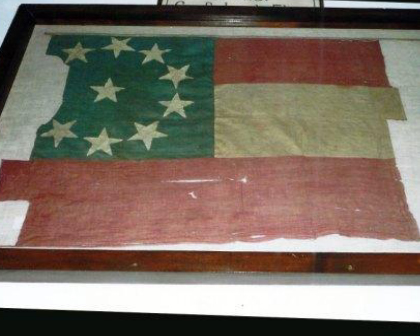
The 11-star silk flag, on display in the War Room at the Sherman House Museum.
This 11-star silk, handmade Confederate national flag was donated to the Fairfield Heritage Association many years ago by Mrs. C.K. Cassell of Rushville with the following note:
This flag was carried in the Civil War by an uncle of Mrs. C.K. Cassell. The mother of Mrs. Cassell was an Adams of McConnelsville, O and he was a brother of her mother. We have no further information. It is pretty worn and if you feel it is too battered to save OK. Thought either the Sherman House or Heritage Assoc might like it.
The flag, of course, is very much worth keeping and is on display in the “War Room” on the second floor of the Sherman House Museum. Pieces were likely cut out by Union soldiers as souvenirs after the flag was captured. One of FCHA’s goals is to raise funds to better preserve the flag through new conservation techniques.
A flag of many versions
On Dec. 20, 1860, South Carolina seceded from the United States and by mid-February of 1861, six other states had followed. Development of a Confederate national flag began immediately and the winning proposal for the Confederacy’s first national flag was called the Stars and Bars. It has been obscured in confusion and inaccuracies for generations since there were several unofficial versions of the flag. But this original Stars and Bars was first flown over the Confederate Capital Building in Montgomery, Alabama, on March 4, 1861, President Lincoln’s inauguration day.
The Stars and Bars was modified when Virginia, North Carolina, Arkansas and Tennessee joined the Confederacy. Then there were 11 states and 11 stars and at least two versions of the Confederate national flag. One version had 11 stars in a circle on a blue canton and another version had 10 stars in a circle with one star in the center of the canton. This unofficial flag was flown from September 1861 through May 1863. That is the version of the flag that is in the Sherman House Museum.
However, the Stars and Bars was used as a battleflag only once — at the First Battle of Bull Run (Manassas) on July 21, 1861. Confusion on the battlefield resulted to a great extent because the U.S. and Confederate flags looked similar, especially from a distance.
The distinctively different battle flag of the Army of Northern Virginia was distributed in November 1861 for use in the field. This is the most widely seen flag today, but it was not the Confederate national flag.
How you can help
Contributions to preserve the flag may be mailed to the FCHA office, 105 E. Wheeling St., Lancaster, OH 43130. Make checks payable to the Fairfield County Heritage Association and please indicate the donation is for the battle flag.